Overview
As healthcare organizations undergo digital transformation, the transition to modern Electronic Health Record (EHR) systems like Epic becomes a critical undertaking. e4health, a nationally recognized leader in healthcare data services, partnered with a major Mid-Atlantic health system to support a complex and high-stakes transition to Epic. With over 300 practices and volumes surpassing 400,000 charts, the scope of work was both vast and multifaceted.
The initiative included the abstraction of vital clinical data across multiple specialties and data sources. This included key elements such as PAMI (Problems, Allergies, Medications, Immunizations), add patient medical, social, surgical histories, health maintenance records, and cancer staging documentation. Notably, the program also supported high-acuity care domains including obstetrics and anticoagulation management. Over 180 FTEs and more than 150 expert clinical abstractors were deployed to ensure clinical accuracy and continuity of care.
Digging Deeper Into Clinical Data Abstraction
Clinical data abstraction is the process of manually reviewing patient charts to extract and transfer meaningful clinical information from legacy systems into a new EHR. This task requires not only familiarity with clinical workflows and medical terminology, but also deep understanding of interoperability standards, regulatory compliance, and provider expectations. In the context of this Epic migration, abstraction ensured that crucial patient data followed clinicians into the new system, avoiding the loss of history that could compromise patient safety, slow down workflows, or lead to costly errors.
For health system executives, abstraction is not a clerical function, it is a strategic imperative. An effective abstraction strategy is key to EHR adoption success, optimal patient care, clinician satisfaction, and measurable return on investment.
The Challenge
The customer operated a sprawling network comprising 15 hospitals and over 100 outpatient sites. Their IT ecosystem included more than two dozen disparate legacy systems, Cerner, Athena, Allscripts, Vista, Meditech, eClinicalWorks, Greenway, and paper charts, making interoperability and standardization a formidable challenge.
The volume of patient data exceeded 10 million records, and the diversity of formats and clinical structures posed significant risk to data integrity. Moreover, the organization faced time-sensitive go-lives and a need to support multiple recent acquisitions and a Community Connect integration.
The Solution
e4health’s clinical abstraction model was built on four core pillars: strategic assessment, phased abstraction, rigorous QA, and seamless Epic integration.
Key Components of e4health’s Abstraction Model:
- Step 1: Comprehensive site assessments and stakeholder engagement
- Step 2: Data element prioritization aligned with safety and compliance
- Step 3: Creation of mapping schemas and standardized data protocols
- Step 4: 6-wave abstraction strategy phased by clinical priority and readiness
- Step 5: Regular audits and quality reviews exceeding 99.9% benchmarks
- Step 6: Collaboration with Epic IT teams to ensure bi-directional validation
Results & Impact
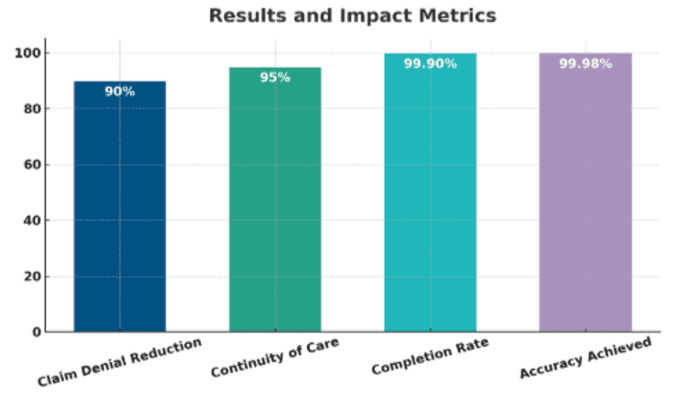
Over 6 waves that have stretched over 5 years, e4health ensured uninterrupted clinical care while abstracting high-priority patient data into Epic. The process was marked by agile adaptation to organizational change and alignment with clinician feedback.
Key Outcomes Include:
- 99.98% accuracy in critical clinical data
- 99.9% abstraction completion within timeline
- Enhanced care continuity and decision-making
- Reduction in claim denials attributed to clean data migration
Lessons Learned
This engagement underscores that successful EHR transitions depend not only on technical implementation, but on clinical data readiness. Early investment in abstraction strategy, robust QA frameworks, and experienced personnel directly translates into downstream benefits, from clinician trust to financial performance.
The Epic transition is a powerful example of operational excellence in digital transformation. By combining the strategic leadership of the customer executive and clinical teams with the abstraction expertise of e4health, the project not only met but exceeded industry benchmarks. The partnership was grounded in shared accountability, a strong governance model, and a clear vision for patient-centered data integrity.
Contact sales@e4.health today to discover how e4health can help your team with our clinical data expertise.