Electrolyte Disorders
Electrolyte imbalances are defined as electrolyte levels that fall outside the normal reference ranges established by institutional laboratories.
Management of these imbalances typically includes correction of the abnormal values, daily monitoring of electrolyte levels, and, when indicated, electrocardiogram (EKG) and cardiac monitoring.
Hypoelectrolytemia (low electrolyte levels) is commonly addressed through oral or intravenous replacement, identification and treatment of the underlying cause, and discontinuation of any contributing medications.
Hyperelectrolytemia (high electrolyte levels) may require more complex management due to the risk of associated complications, necessitating close monitoring and supportive are.
Syndrome of Inappropriate Antidiuretic Hormone Secretion (SIADH) involves excessive release of antidiuretic hormone (ADH) and is characterized by hyponatremia that is unresponsive to standard treatment protocols.
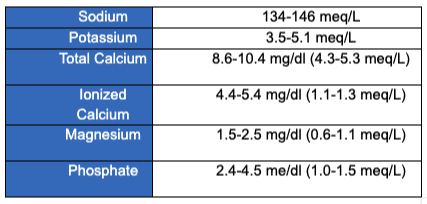
Diagnostic Criteria
* Example of normal electrolyte reference ranges (varies by institution)
Coding Considerations
- The ICD-10-CM codes for hyponatremia (E87.1) and hypernatremia (E87.0) are classified as Complications or Comorbidities (CCs) and are associated with a Severity of Illness (SOI) score of 2.
- Electrolyte disorders are included as Vizient quality variables across numerous Diagnosis-Related Groups (DRGs).
- Accurate provider documentation is essential. Descriptive terms such as “low sodium” are not equivalent to a medical diagnosis and do not support code assignment. A formal diagnostic term (e.g., hyponatremia) must be documented.
- Code assignment for electrolyte imbalances requires evidence of clinical significance, such as treatment, monitoring, or an extended length of stay related to the condition.
CDI Practice Considerations
In patients admitted with elevated blood glucose levels and low sodium, the presentation may reflect pseudohyponatremia. In such cases, it is important to determine whether the sodium level is truly low by performing a corrected sodium calculation. This can be done using a sodium correction formula for hyperglycemia ( e.g. Sodium Correction for Hyperglycemia).
Query opportunities to review for when patients have electrolyte abnormalities:
- Acute Kidney Injury (AKI): May be associated with dehydration and electrolyte imbalance.
- SIADH: Consider when sodium levels are unresponsive to standard treatment.
- Congestive Heart Failure (CHF): Patients may present with fluid overload, contributing to electrolyte disturbances.
- Metabolic Encephalopathy: Significant deviations in sodium levels can lead to altered mental status. When sodium is corrected and the patient returns to baseline, review for the presence of metabolic encephalopathy and query as necessary.
- Symptom PDx: When the principal diagnosis is a symptom code (e.g., confusion, syncope, weakness), there may be an opportunity to query the provider to determine and document an underlying etiology-such as an electrolyte imbalance-to establish a more clinically specific and diagnostically meaningful principal diagnosis.
Looking for CDI help?
e4health CDI Education
Need help to earn CEUs or education your team? Visit the IQ Education Center and get your free account or contact us for more information. e4health is dedicated to elevating the business of healthcare. We are committed to offering support and the most current information and updates to collaborate with coding and CDI professionals to realize their fullest potential. We enthusiastically seek opportunities to develop ourselves and each other. We understand that knowledge is the key to success for our clients navigating the ever-changing health information management landscape.
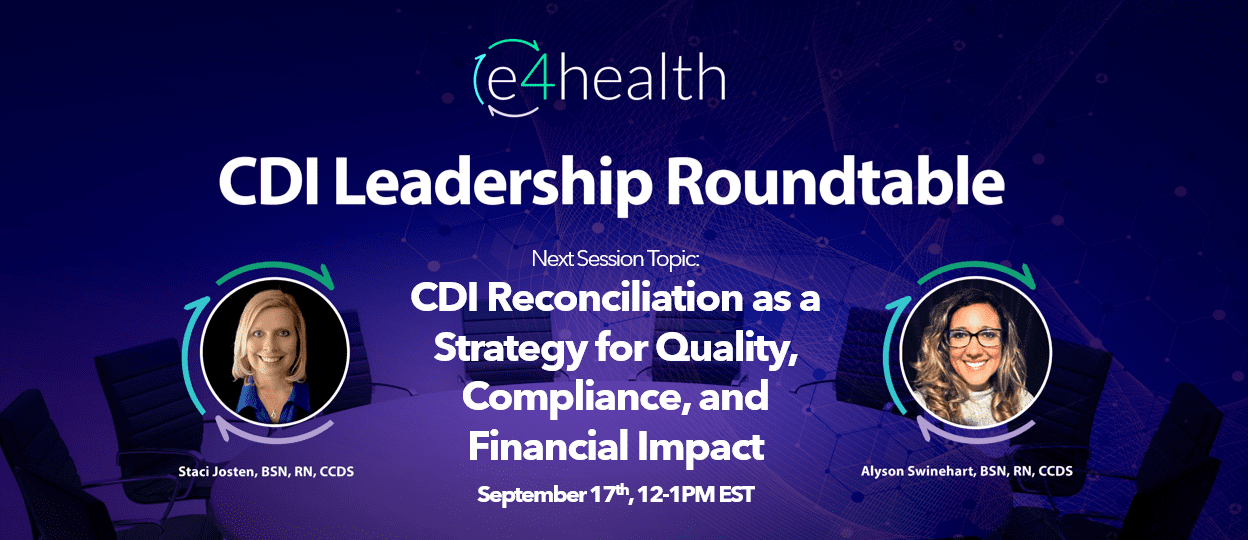
Earn FREE ACDIS CEUs when you join Staci Josten, RN, BSN, CCDS, Alyson Swinehart, BSN, RN, CCDS, and other CDI leaders for a roundtable discussion regarding important, timely industry topics! The topic for September’s discussion is CDI Reconciliation as a Strategy for Quality, Compliance, and Financial Impact. We will provide background on this topic, share industry insights, and facilitate collaborative discussion with guided questions and answers.
Objectives:
- Define the concept othe concept of reconciliation and explore its strategic impact on program performance and outcomes
- Identify real-world examples that demonstrate measurable improvements resulting from accurate reconciliation practices that directly show impact made because of accurate reconciliation
- Understand benefits of reconciliation associated with an effective reconciliation process
Click here to register!
What is the e4health CDI Leadership Roundtable?
The goal for the virtual CDI Leadership Roundtable Discussion is for CDI leaders to explore specific topics within CDI, learn about the topic and from each other. During each roundtable, e4health CDI Leader’s will present a CDI topic, spend time sharing current industry standards or some education regarding this topic and then open with probing questions for group discussion.
Who should attend the e4health CDI Leadership Roundtable?
The focus of this group is for those who have influence over CDI program process, policy, and education.
Why should I attend the e4health CDI Roundtable?
This will be a wonderful place to learn, share your wins and challenges and collaborate with other CDI leaders across the industry. Also, after completing a survey, free ACDIS CEUs will be earned.
The information and opinions presented here are based on the experience, training, and interpretation of e4health. Although the information has been researched and reviewed for accuracy, e4health does not accept any responsibility or liability regarding errors, omissions, misuse, or misinterpretation. This information is intended as a guide; it should not be considered a legal/consulting opinion or advice.