
Topic: Rhabdomyolysis
Definition: Muscle necrosis with release of creatine kinase (CK), potassium, phosphate and myoglobin into the blood stream. The causes can be traumatic or non-traumatic
- Traumatic- any severe soft tissue/muscle trauma
- External causes-intense physical activity such as extreme weightlifting
- Non-traumatic-infections, drugs, toxins, or metabolic disorders. Ischemia, such as prolonged pressure on muscle tissue after a fall, can cause rhabdomyolysis. The fall itself is not the cause; rather, it’s the resulting muscle ischemia due to the prolonged pressure.
Diagnostic Criteria:
- CK levels at presentation are typically 5 times the upper limit of normal, and can range from 1,500-100K u/L.
- Normal levels can range 22-198 u/L depending on lab test used
- Myoglobin may be present in urine, but it is quickly eliminated
- Clinical presentations may include muscle pain (50% of cases), weakness and dark-colored urine
- The condition may result in Acute Kidney Injury (AKI)/Acute Tubular Necrosis (ATN) and electrolyte abnormalities
- Treatment includes aggressive IV fluid hydration and correction of electrolyte imbalance

Coding Considerations:
- High CK levels can often be indicative of an acute MI, and this could be a differential diagnosis upon admission.
- It is important to always consider the definition of principal diagnosis when coding: that condition established after study to be chiefly responsible for occasioning the admission of the patient to the hospital for care.
- Coding Clinics to consider:
- AHA Coding Clinic 2002 Third Quarter, p. 28: Acute renal failure due to rhabdomyolysis
- AHA Coding Clinic 2019 Second Quarter, p. 12: Rhabdomyolysis (traumatic vs non-traumatic)
CDI Practice Considerations:
- Rhabdomyolysis is assigned to ICD-10-CM code M62.82 and is recognized as a Complication/Comorbidity (CC) whereas Traumatic Rhabdomyolysis is assigned code T79.6XXA and is a non-CC.
- The term traumatic rhabdomyolysis should be reserved for cases involving significant trauma, and not for situations such as prolonged immobility after a fall without evidence of severe injury.
- Traumatic rhabdomyolysis should only be coded when explicitly documented by the provider.
- A urine dipstick may yield a false positive for blood in the absence of or with minimal red blood cells (RBCs), often due to the presence of myoglobin, which is commonly seen in rhabdomyolysis.
- When AKI or ATN is the primary focus of treatment, it may be appropriate to assign it as the principal diagnosis.
Query Opportunity:
- Query as necessary, based on clinical indicators, to clarify whether the rhabdomyolysis is traumatic in nature.
- AKI secondary to rhabdomyolysis is almost always due to ATN, though ATN may not be explicitly documented. In such cases, a provider query may be warranted to clarify the underlying etiology.
- When a patient is admitted with significant traumatic fractures (e.g., hip or femur) review for traumatic rhabdomyolysis querying as necessary, as when traumatic rhabdomyolysis is added the MS-DRG assignment shifts to 963–965: Other Multiple Significant Trauma. This can significantly affect reimbursement and resource utilization
Looking for CDI help?
Learn more about e4health CDI Solutions. Our Team is leading the way in the CDI industry.
e4health CDI Education
Need help to earn CEUs or education your team? Visit the IQ Education Center and get your free account or contact us for more information. e4health is dedicated to elevating the business of healthcare. We are committed to offering support and the most current information and updates to collaborate with coding and CDI professionals to realize their fullest potential. We enthusiastically seek opportunities to develop ourselves and each other. We understand that knowledge is the key to success for our clients navigating the ever-changing health information management landscape.
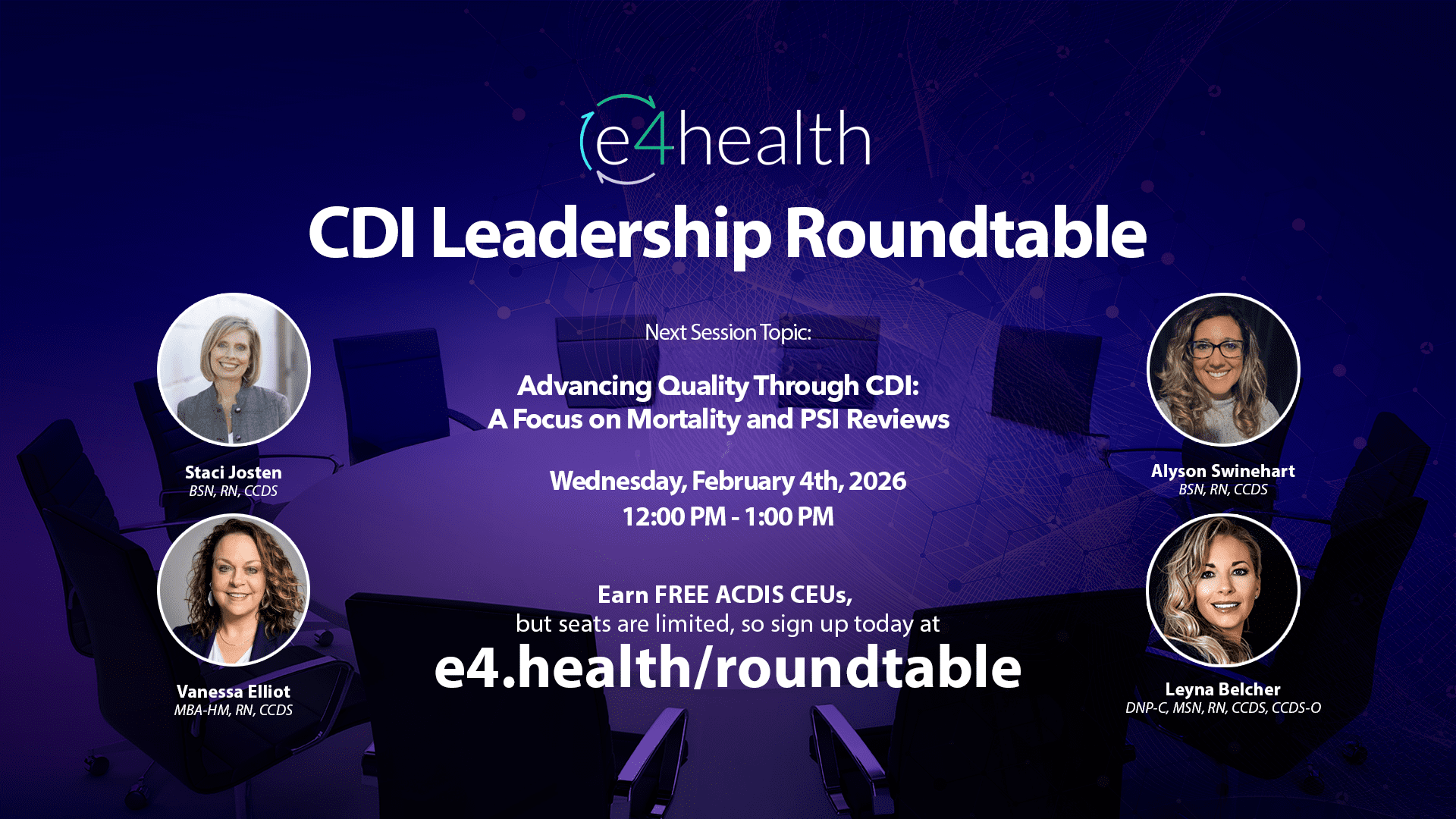
Earn FREE ACDIS CEUs when you join Staci Josten, RN, BSN, CCDS, Alyson Swinehart, BSN, RN, CCDS, and other CDI leaders for a roundtable discussion regarding important, timely industry topics! The topic for February’s discussion is Advancing Quality Through CDI: A Focus on Mortality and PSI Reviews. We will provide background on this topic, share industry insights, and facilitate collaborative discussion with guided questions and answers
Click here to register!
What is the e4health CDI Leadership Roundtable?
The goal for the virtual CDI Leadership Roundtable Discussion is for CDI leaders to explore specific topics within CDI, learn about the topic and from each other. During each roundtable, e4health CDI Leader’s will present a CDI topic, spend time sharing current industry standards or some education regarding this topic and then open with probing questions for group discussion.
Who should attend the e4health CDI Leadership Roundtable?
The focus of this group is for those who have influence over CDI program process, policy, and education.
Why should I attend the e4health CDI Roundtable?
This will be a wonderful place to learn, share your wins and challenges and collaborate with other CDI leaders across the industry. Also, after completing a survey, free ACDIS CEUs will be earned.
The information and opinions presented here are based on the experience, training, and interpretation of e4health. Although the information has been researched and reviewed for accuracy, e4health does not accept any responsibility or liability regarding errors, omissions, misuse, or misinterpretation. This information is intended as a guide; it should not be considered a legal/consulting opinion or advice.